Genomics view markdown
notes on genomics, mostly as related to neurological disease/disorders
- human genome has ≈ 3.1 billion base pairs
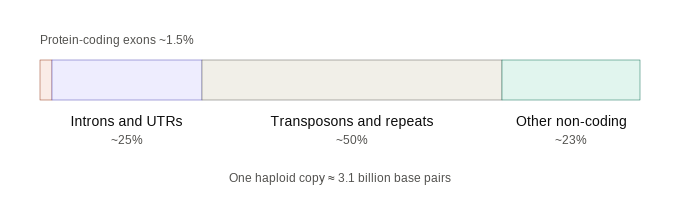
- protein-coding part is called exome
- a typical person carries about 4–5 million variant sites
- Most are SNPs, single-letter changes
- Insertions, deletions and larger structural variants are fewer in number but cover more total base pairs
- copy-number variant deletes or duplicates a stretch of chromosome
- GWAS basics
- collect people (thousands-millions)
- genotype them (cheaper to SNP array subset rather than whole-genome)
- impute missing stuff (because nearby variants tend to be inherited together in blocks, a pattern called linkage disequilibrium (LD))
- For each SNP, run a regression of trait ~ genotype (0, 1 or 2 copies of the allele). Include covariates like age, sex and ancestry principal components.
- correct for multiple testing
- output is often polygenic - implicates many genes
- post-GWAS followup
- issues
- Linkage disequilibrium (LD). Nearby SNPs are inherited together in blocks. The GWAS flags the whole block, so the actual causal variant could be any of dozens of correlated SNPs.
- Non-coding variants. Most associated SNPs lie outside protein-coding sequence. They probably act by changing how much of a gene is made, not what the protein is.
- Long-range regulation. A regulatory element can control a gene hundreds of thousands of DNA letters away, skipping the nearest gene entirely.
- solutions
- Statistical fine-mapping ranks which SNP in a block is most likely causal.
- Expression quantitative trait loci (eQTLs) are SNPs whose versions change a gene’s expression level. If a risk SNP is also an eQTL for gene X, gene X becomes a candidate.
- Chromatin contact maps (Hi-C) show which distant DNA regions physically touch inside the nucleus, linking a regulatory SNP to its target gene. Chapter 8 returns to this.
- issues