Motor system view markdown
notes from Purves et al. "Neuroscience", 5th edition (chapter numbers in headers) + Intro to neurobiology course at UVA
16 lower
- sensory in dorsal spinal cord, motor in ventral
- farther out neurons control farther out body parts (medial=trunk, lateral=arms,legs)
- one motor neuron (MN) innervates multiple fibers
- the more fibers/neuron, the less precise
- MN pool - group of MNs=motor units
- muscle tone = all your muscles are a little on, kind of like turning on the car engine and when you want to, you can move forward
- more firing = more contraction
- MN types
- fast fatiguable - white muscle
- fast fatigue-resistant
- slow - red muscles, make atp
- muscles are innervated by a proportion of these MNs
- reflex
- whenever you get positive signal on one side, also get negative on other
- flexor - curl in (bicep)
- extensor - extend (tricep)
- proprioceptors (+) - measure length - more you stretch, more firing of alpha MN to contract
- intrafusal muscle=spindle - stretches the proprioceptor so that it can measure even when muscle is already stretched
- $\gamma$ motor neuron - adjusts intrafusal muscles until they are just right
- keeps muscles tight so you know how much muscle is streteched
- if alpha fires a lot, gamma will increase as well
- high gamma allows for fast responsiveness - brainstem modulators (serotonin) also do this
- opposes muscle stretch to keep it fixed
- spindle -> activates muscles -> contracts -> turns off
- sensory neurons / gamma MNs innervate muscle spindle
- $\gamma$ motor neuron - adjusts intrafusal muscles until they are just right
- homonymous MNs go into same muscle, antagonistic muscle pushes other way
- intrafusal muscle=spindle - stretches the proprioceptor so that it can measure even when muscle is already stretched
- golgi tendon (-) measures pressure not stretch
- safety switch
- inhibits homonymous neuron so you don’t rip muscle off
- ALS = Lou Gehrig’s disease
- MNs are degenerating - reflexes don’t work
- progressive loss of $\alpha$ MNs
- last neuron to go is superior rectus muscle -> people use eyes to talk with tracker
- CPG = central pattern generator
- ex. step on pin, lift up leg
- walking works even if you cut cat’s spinal cord
- collection of interneurons
17 upper
-
signs and symptoms of upper and lower motor neuron lesions (table 17.1)
upper motor neuron syndrome lower motor neuron syndrome weakness weakness or paralysis spasticity decreased superficial reflexes increased tone hypoactive deep reflexes hyperactive deep reflexes decreased tone clonus fasciculations and fibrillations Babinski’s sign severe muscle atrophy loss of fine voluntary movements 

- cAMP is used by GPCR
- lift and hold circuit
- ctx->lateral white matter->lateral ventral horn->limb muscles
- lateral white matter - most sensitive to injury
- brainstem->medial white matter->medial horn->trunk
- medial white matter -> goes into trunk
- ctx->lateral white matter->lateral ventral horn->limb muscles
- bulbarspinal tracts
- lateral and medial vestibulospinal tracts - feedback
- automated system - not much thinking
- posture - reflex
- too slow for learning surfing
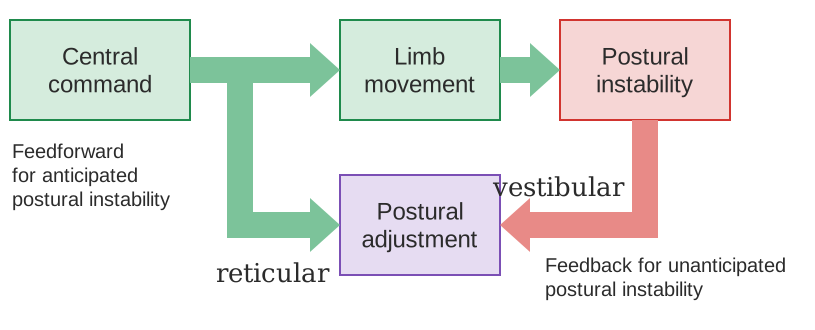
- reticular - feedforward = anticipate things before they happen
- command / control system for trunk muscles (posture)
- feedforward - not a reflex, lean back before opening drawer
- caudal pontine - feeds into spinal cord
- colliculospinal tract
- has superior colliculus - eye muscles, neck-looking
- see ch. 20 - reflex
- lateral and medial vestibulospinal tracts - feedback
- corticular bulbar tract (premotor->primary motor->brainstem)
- motor cortexes - this info is descending
- can override reticular reflexes in reticular formation
- premotor cortex (P2) - contains all actions you can do
- has mirror neurons that fire ahead of primary neurons
- fire if you think about it or if you do it
- has mirror neurons that fire ahead of primary neurons
- primary motor cortex (P1)
- layer 1 ascending
- layer 4 input
- layer 5 - Betz cells - behave like 6 (output)
- layer 6 - descending output
- has map like S1 does
- Jacksonian march get seizure that goes from feet to face (usually one side)
- epileptic seizure - neurons fire too much and fire neurons near them
- insular - flashes of moods
- pyriform - flashes of smells
- epileptic seizure - neurons fire too much and fire neurons near them
- Jacksonian march get seizure that goes from feet to face (usually one side)
- Betz cells - if they fire, you will do something
- dictate a goal, not single neuron to fire
- axons to ventral horn of spinal cord
- lesions
- upper
- spasticity - unorganized leg motions
- increased tone - tight muscles
- hyperactive deep reflexes
- ex. babinski’s sign
- curl foot down a lot because you don’t know how much to curl
- curling foot down = normal plantar
- more serotonin can cause this
- lower
- hypoactive deep reflexes
- decreased tone
- severe muscle atrophy
- upper
- pathways
- Betz cell
- 90% cross midline in brainstem - control limbs
- 10% don’t cross - trunk muscles
- Betz cell
18 basal ganglia (choose what you want to do)

- “who you are”
- outputs
- brainstem
- motor cortex
- 4 loops (last 2 aren’t really covered)
- motor loops
- body movement loop
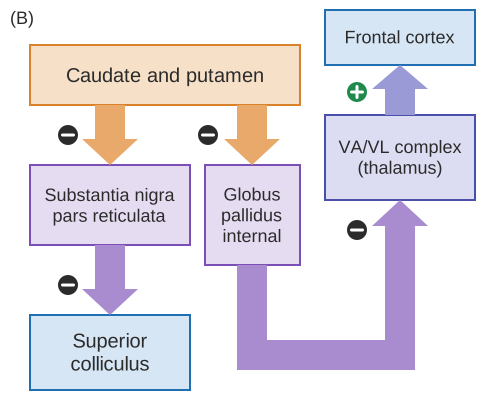
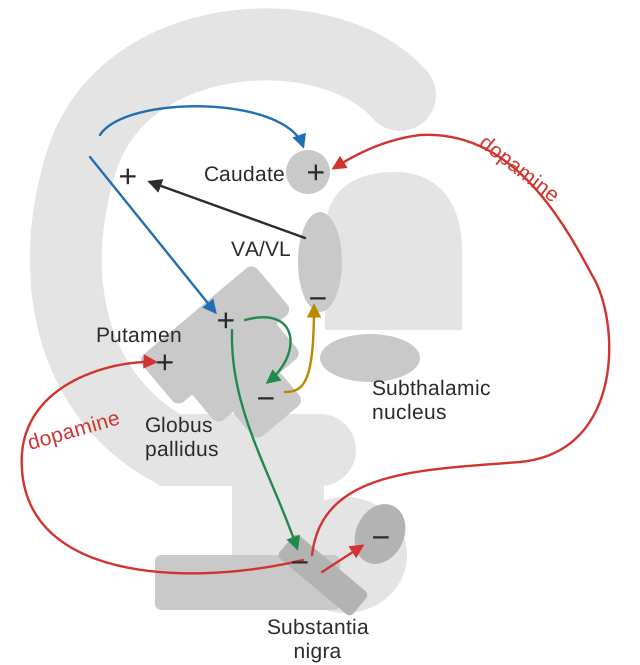
- SnC -> S (CP) -> (-) Gp -> (-) VA/VL -> motor cortex
- oculomotor loop
- cortex -> caudate -> substantia nigra pars reticulata -> superior colliculus
- body movement loop
- non-motor loops
- prefrontal loop - daydreaming (higher-order function)
- spiny neurons corresponding to a silly idea (alien coming after you) filtered out because not fired enough
- schizophrenia - can’t filter that out
- limbic loop - mood
- has nucleus accumbens
- can make mood better with dopamine
- prefrontal loop - daydreaming (higher-order function)
- motor loops
- substantia nigra
- pars compacta - dopaminergic neurons (input to striatum)
- more dopamine = more strength between cortical pyramidal neurons and spiny neurons (turns up the gain)
- dopamine helps activate a spiny neuron
- may be the ones that learn (positive outcome is saved, will result in more dopamine later)
- Parkinson’s - specific loss of dopaminergic neurons
- dopaminergic neurons form melanin = dark color
- when you get down to 20% what you were born with
- know what they need to do - don’t have enough dopamine to act
- treat with L Dopa -> something like dopamine -> take out globus pallidus
- cocaine, amphetamine - too much dopamine
- Huntington’s - death of specific class of spiny neurons
- have uncontrolled actions
- Tourette’s - too much dopamine
- also alcohol
- MPPP (synthetic heroin)
- MPTP looks like dopamine but turns into MPP and kills dopaminergic neurons
- treated with L Dopa to reactivate spiny neurons
- pars reticulata
- doesn’t have dopamine (output from striatum)
- striatum contains spiny neurons
- caudate (for vision) - output to globus pallidus and substantia nigra (pars reticulata)
- putamen - output only to globus pallidus
- each spiny neuron gets input from ~1000 cortical pyramidal cells
- globus pallidus
- each spiny neuron connects to one globus pallidus neuron
- deja vu - spiny neuron you haven’t fired in a while
- VA/VL (thalamus)
- all motor actions must go through here before cortex
- has series of commands of all actions you can do
- has parallel set of betz cells that will illicit those actions
- VA/VL is always firing, globus pallidus inhibits it (tonic connection)
- pars compacta - dopaminergic neurons (input to striatum)
19 cerebellum (fine tuning all your motion)
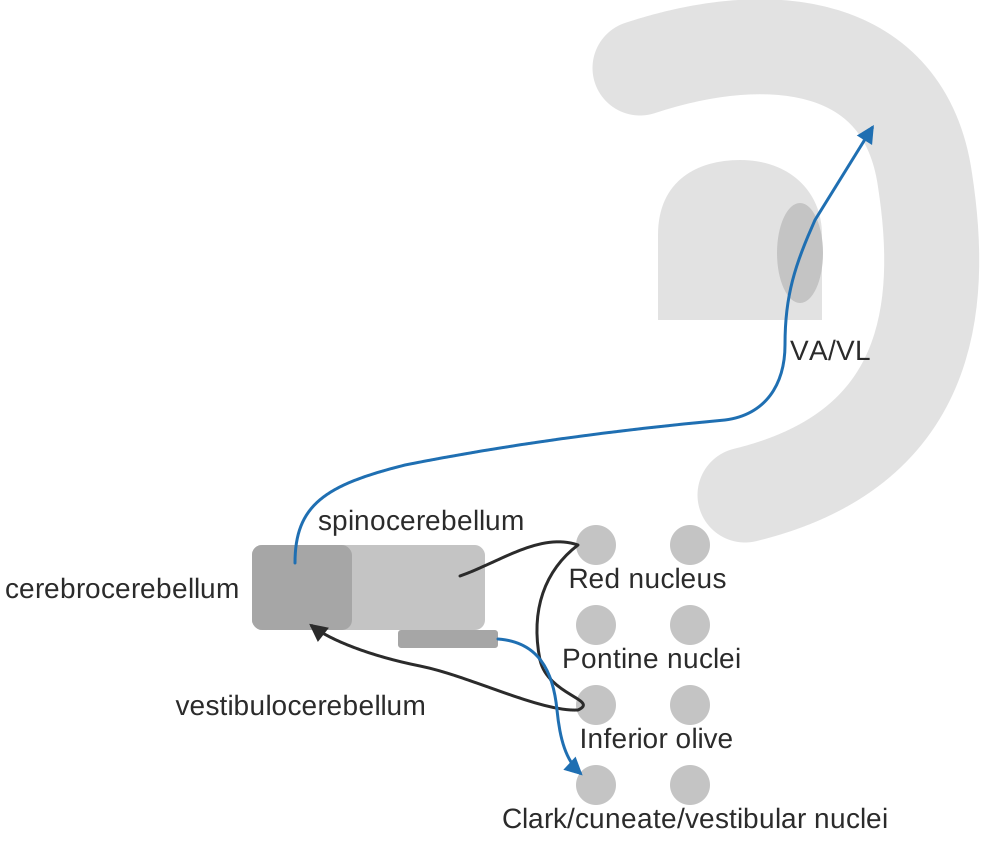

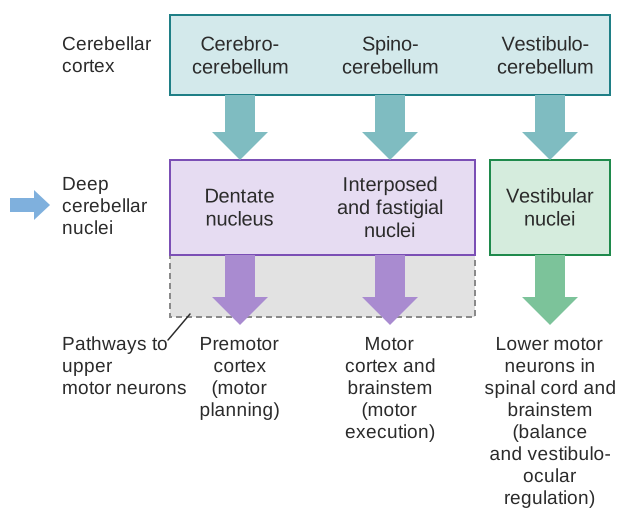
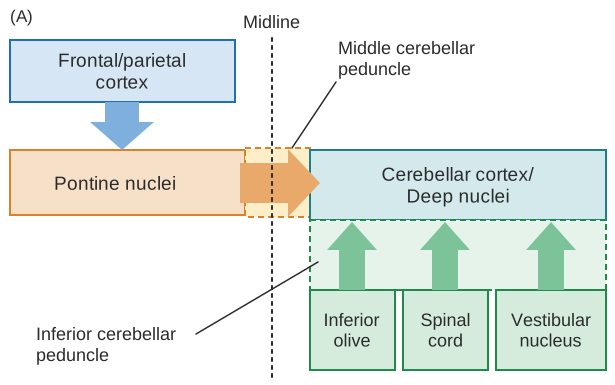
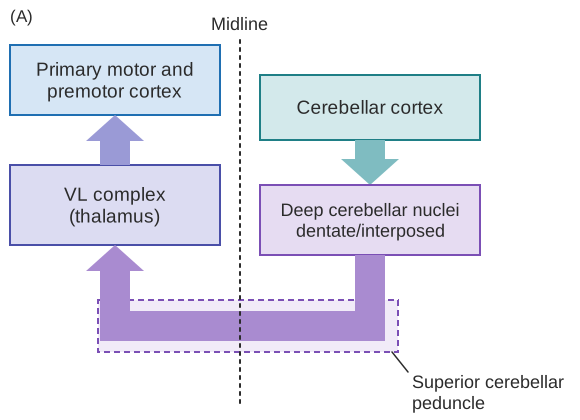
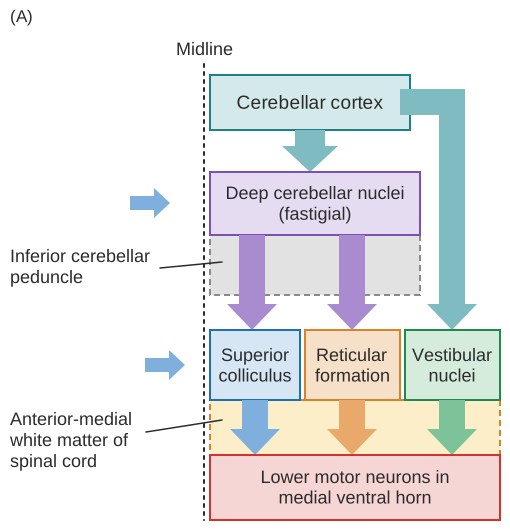
- redundant system - cortex could do all of this, but would be slow
- repeated circuit - interesting for neuroscientists
- all info comes in, gets processed and goes back out
- cerebellum gets motor efferant copy
- all structures on your brain that do processing send out efferent
- cerebellum sends efferant copy back to itself with time delay (through inferior olive)
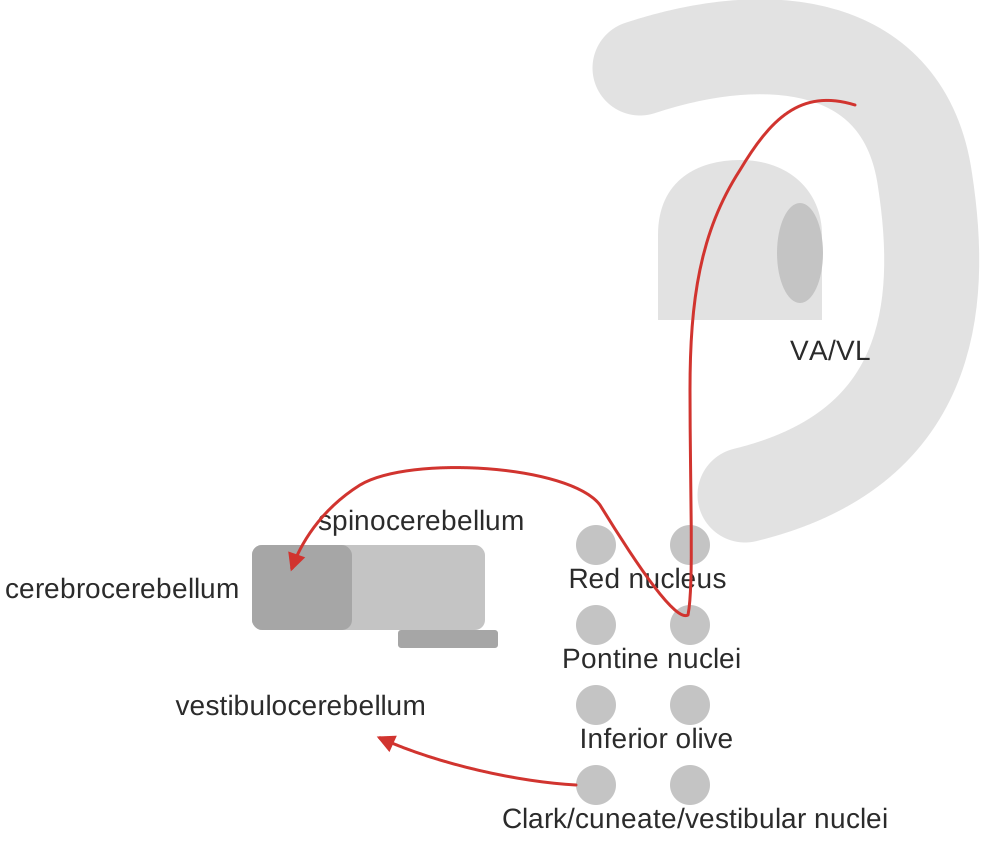
- cerebrocerebellum
- deals with premotor cortex (mostly motor cortex)
- spinocerebellum = clarke’s nucleus, knows stretch of every muscle, many proprioceptors go straight into here
- motor cortex
- has a map of muscles
- vestibular cerebellum - vestibular->cerebellum->vestibular
- vestibular system leans you back but if wind blows, have to adjust to that
- input
- pontine nuclei (from cortex)
- vestibular nuclei (balance)
- cuneate nucleus (somatosensory from spinal upper body)
- clarke (proprio from spinal lower body)
- processing
- cerebellar deep nuclei
- output
- deep cerebellar nuclei
- go to superior colliculus, reticular formation
- VA/VL (thalamus) - back to cortex
- red nucleus
- deep cerebellar nuclei
- circuit 1 - fine-tuning
- circuit 2 - detects differences, adjusts
- cerebellum -> red nucleus (is an efferant copy) -> inferior olive -> cerebellum
- compare new copy to old copy
- cells
- purkinje cells - huge number of dendrite branches - dead planar allows good imaging
- GABAergic
- (input) mossy fibers -(+)> granule cells (send parallel fibers) -(+)> purkinje cell -(-)> deep cerebellar nuclei (output)
- mossy->granule->parallel fibers connect to ~100,000 parallel fibers
- climbing fiber - comes from inferior olive and goes back to purkinje cell (this is the efferent copy) = training signal
- loops
- deep excitatory loop (climbing/mossy) -(+)-> deep cerebellar nuclei
- cortical inhibitory loop (climbing/granule) -(+)-> purkinje
- the negative is from purkinje to deep cerebellar nuclei
- purkinje cells - huge number of dendrite branches - dead planar allows good imaging
- alcohol
- can create gaps = folia
- long-term use causes degeneration = ataxia (lack of coordination)
20 eye movements/integration


- Broca’s view - look at people with problems
- Ramon y Cajal - look at circuits
- 5 kinds of eye movements
- saccades
- use cortex, superior colliculus (visual info -> LGN -> cortex, 10% goes to brainstem)
- constantly moving eyes around (fovea)
- ~scan at 30 Hz
- 5 Hz=200 ms for cortex to process so pause eyes (get 5-6 images)
- there is a little bit of drift
- can’t control this
- humans are better than other animals at seeing things that aren’t moving
- VOR - vestibular ocular reflex - keeps eyes still
- use vestibular system, occurs in comatose
- fast
- works better if you move your head fast
- optokinetic system - tracks with eyes
- ex. stick head out window of car and track objects as they go by
- slower than VOR (takes 200 ms)
- works better if slower
- reflex
- in cortex (textbooks) but probs brainstem (new)
- smooth pursuit - can track things moving very fast
- suppress saccades and track smoothly
- only in higher apes
- area MT is highest area of motion coding and goes up and comes down multiple ways
- high speed processing isn’t understood
- could be retina processing
- vergence - crossing your eyes
- suppresses conjugate eye movements
- we can control this
- only humans - bring objects up very close
- reading uses this
- saccades
- eye muscles
- rectus
- vertical
- superior
- inferior
- use complicated vertical gaze center
- last to degenerate in ALS
- locked-in syndrome - can only move eyes vertically
- controls oculomotor nucleus
- lateral
- medial
- lateral (controlled by abducens)
- use horizontal gaze center=PPRF which talk to abducens -MLF connects abducents to opposite medial lateral rectus muscle
- oblique - more circular motions
- superior (controlled by trochlear nucleus)
- inferior
- vertical
- everything else controlled by oculomotor nucleus
- rectus
- superior colliculus has visual map
- controls saccades, connects to gaze centers
- takes input from basal ganglia (oculomotor loop)
- also gets audio input from inferior colliculus (hear someone behind you and turn)
- gets strokes
- redundant with frontal eye field in secondary motor cortex
- connects to superior colliculus, gaze center, and comes back
- if you lose one of these, the other will replace it
- if you lose both, can’t saccade to that side
21 visceral (how you control organs, stress levels, etc.)

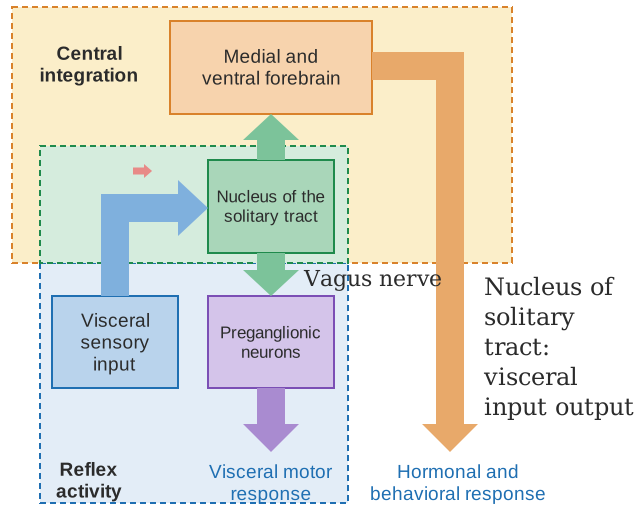
- A central autonomic network for the control of visceral motor function
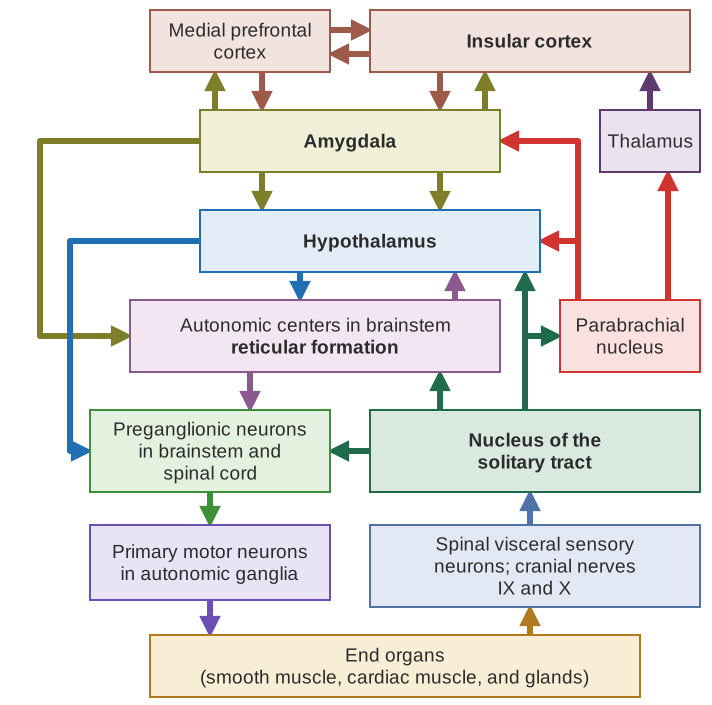
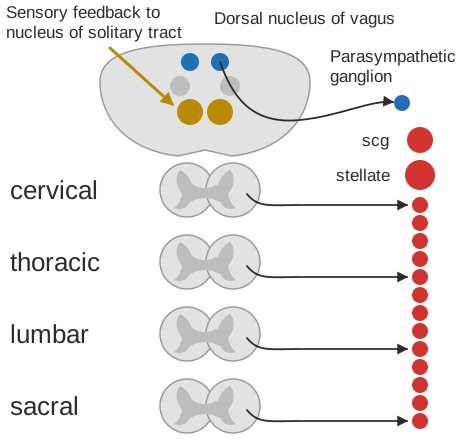
- parasympathetic works against sympathetic
- divisions
- sympathetic - fight-or-flight (adrenaline)
- functions
- neurons to smooth muscle
- pupils dilate
- increases heart rate
- turn off digestive system
- 2 things with no parasympathetic counterpart
- increase BP
- sweat glands
- location
- neurons in spinal cord lateral horn
- send out neurons to sympathetic trunk (along the spinal cord)
- all outgoing connections are adrenergic
- neurons in spinal cord lateral horn
- beta-adrenergic drugs block adrenaline
- beta agonist - activates adrenaline receptors (do this before EKG)
- functions
- parasympathetic - relaxing (ACh)
- location
- brainstem
- edinger westphal nucleus - pupil-constriction
- salivatory nucleus
- vagus nucleus - digestive system, sexual function
- nucleus ambiguous - heart
- nucleus of the solitary tract
- all input/output goes through this
- rostral part (front) - taste neurons
- caudal part (back) contains all sensory information of viscera (ex. BP, heart rate, sexual
- sacral spinal cord (bottom) - gut/bladder/genitals
- not parallel to sympathetic – poor design - may cause stress-associated diseases
- hard to make drugs with ACh
- not parallel to sympathetic – poor design - may cause stress-associated diseases
- enteric nervous system - in your gut
- takes input through vagus nerve from vagus nucleus
- also has sensory neurons and sends afferents back to brainstem
- sympathetic - fight-or-flight (adrenaline)
- pathway
- insular cortex - what you care about
- amygdala - contains emotional memories
- hypothalamus - controls a lot
- mostly peptinergin neurons
- aging, digestion, mood, straight to bloodstream & CNS
- releases hormones
- ex. leptin - stops you eating when you eat calories
- reticular formation - feedforward, prepares digestion before we eat
- three examples
- heart rate
- starts at nucleus ambiguous
- also takes input from chemoreceptors (ex. pH)
- SA node at heart generates heartbeat - balances Ach and adrenaline
- sympathetic sends info from thoracic spinal cord
- heart sends back baroreceptor afferents
- bladder function
- parasympathetic in sacral lateral horn make you pee (contracts bladder)
- turn off sympathetic NS
- open sphincter muscle (voluntary)
- can also control this via skeletal nervous system
- circuit
- amygdala (can’t pee when nervous)
- pontine micturation center -> parasympathetic preganglionic neurons -> parasympathetic ganglionic neurons
- inhibitory local circuit neurons -> somatic MNs
- sexual function
- Viagra turns on parasympathetic NS
- also gives temporal color blindness
- sympathetic involved in ejaculation
- temporal correlation (“Point and Shoot”)
- Viagra turns on parasympathetic NS
- heart rate